RESEARCH-LED EXPERIENCE DESIGN · EMOTIONAL DESIGN · 2026
Echo Archive
A sonic archive for the emotional experience of pregnancy.
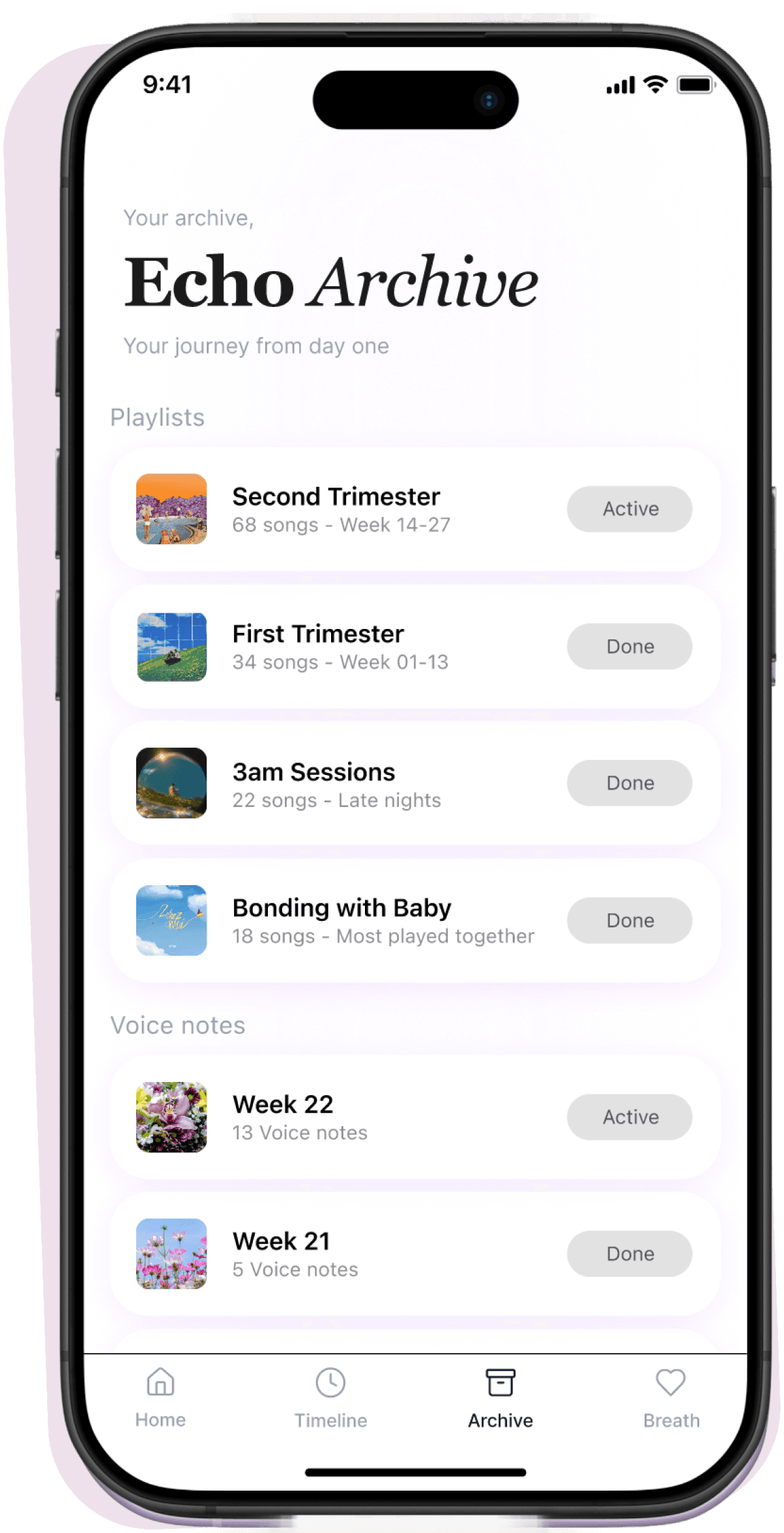
Echo Archive pairs a mobile app with a tactile Worry Stone to help pregnant individuals preserve voice notes, songs and meaningful moments throughout pregnancy as a keepsake that can be revisited and passed on.
RESEARCH SYNTHESIS
EXPERIENCE STRATEGY
EMOTIONAL INTERACTION DESIGN
HYBRID DESIGN CONCEPT
ROLE
Researcher & Experience Design Contributor
TEAM
5-person design team
DURATION
12 weeks
TYPE
Research-led experience design
OUTCOME
Research-led sonic archive concept
Hybrid app + tactile object system
Emotional reflection + future inheritance
QUICK OVERVIEW
THE INSIGHT
Pregnancy is tracked physically, but the lived emotional experience is what people most wanted to hold onto.
THE RESPONSE
A hybrid app and tactile Worry Stone that helps pregnant individuals preserve voice notes, songs and feelings as a sonic archive.
MY ROLE
I led research synthesis and translated participant insights into the archive experience, capture interactions and Worry Stone direction across a 5-person team.
WHY THIS MATTERS
Why this mattered.
Pregnancy memories are not only clinical milestones. They are private, emotional and often hard to hold onto. Echo Archive explored how design could preserve what pregnancy felt like, not just what happened.
FOR THE INDIVIDUAL
A private way to capture feelings without needing to explain them immediately.
FOR MEMORY
A way to revisit moments across pregnancy, not just track milestones.
FOR INHERITANCE
A keepsake that could become part of the child's story.
THE REAL PROBLEM
Pregnancy is tracked physically, but remembered emotionally.
"There's always this underlying worry, even when things are going well."
DIRECT PARTICIPANT QUOTE
Existing pregnancy tools support the physical experience: appointments, symptoms and fetal development. Our research explored what sits outside those systems: emotional labour, identity shifts, cultural connection, bonding through sound and fleeting moments that are hard to preserve.
PREGNANCY TOOLS USUALLY SUPPORT
Appointments
Symptoms
Fetal development
Clinical measurements
WHAT PREGNANT INDIVIDUALS ALSO EXPERIENCE
Anxiety
Identity shifts
Cultural distance
Emotional labour
Fleeting moments worth preserving
Technology addresses the physical
Echo Archive holds the emotional
WHAT RESEARCH REVEALED
The concept came from synthesis, not assumption.
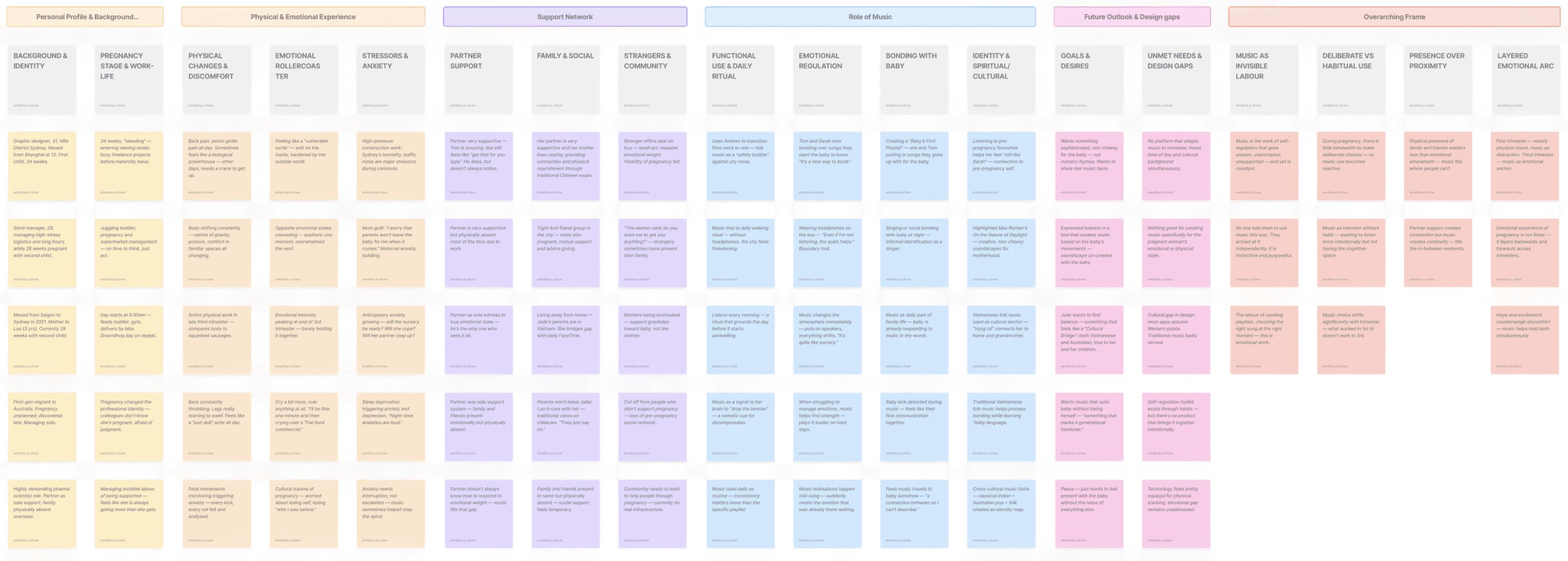
Themes were synthesised from participant accounts of music use, emotional overwhelm, support gaps and cultural connection.
RESEARCH SYNTHESIS
10 participant interviews · 6 theme clusters · affinity mapping
01
Music as emotional regulation
Participants used music to steady themselves during anxiety, overwhelm or fatigue.
DESIGN MEANING
Build on existing behaviour.
02
Sound as cultural lifeline
Songs and lullabies kept participants connected to family, heritage and identity.
DESIGN MEANING
Treat sound as memory, not just audio.
03
Support exists, but emotional needs stay private
Support was present, but did not always reach what participants felt in the moment.
DESIGN MEANING
Create a private, low-pressure space for expression.
04
Emotional moments are meaningful but fleeting
Feelings were vivid in the moment but hard to capture or revisit later.
DESIGN MEANING
Turn passing moments into something keepable.
CENTRAL INSIGHT
Participants were not lacking support. They were lacking a way to hold and revisit the emotional texture of what they were going through.
REFRAMING THE OPPORTUNITY
From music support to emotional meaning-making.
CONCEPT EVOLUTION
INITIAL FOCUS
Music for emotional wellbeing during pregnancy
RESEARCH REVEALED
Music was already used emotionally, but passively and without reflection
DESIGN SHIFT
From recommending music to preserving emotional meaning
FINAL CONCEPT
A sonic archive of pregnancy memories
EXPERIENCE GOALS
01
Low-pressure capture
Capture should feel quick, private and optional.
02
Feeling over measurement
The archive should reflect meaning, not performance.
03
Agency in sensitive moments
Users should feel in control, not guided too forcefully.
04
Physical and digital continuity
The Worry Stone and app should feel like one connected keepsake system.
EXPERIENTIAL SHIFTS
Invisible → Articulated
Emotional labour often goes unnamed, so the design gives people a low-pressure way to record and acknowledge it.
Isolation → Cultural Grounding
For those distanced from family, sound becomes a way to preserve connection, language and ritual.
Ephemeral → Inherited
Vivid in the moment but easily lost, meaningful memories become part of a keepsake that can be passed on.
THE DESIGN RESPONSE
A hybrid system for capturing emotional moments.
The capture experience had to fit into emotional moments without interrupting them.
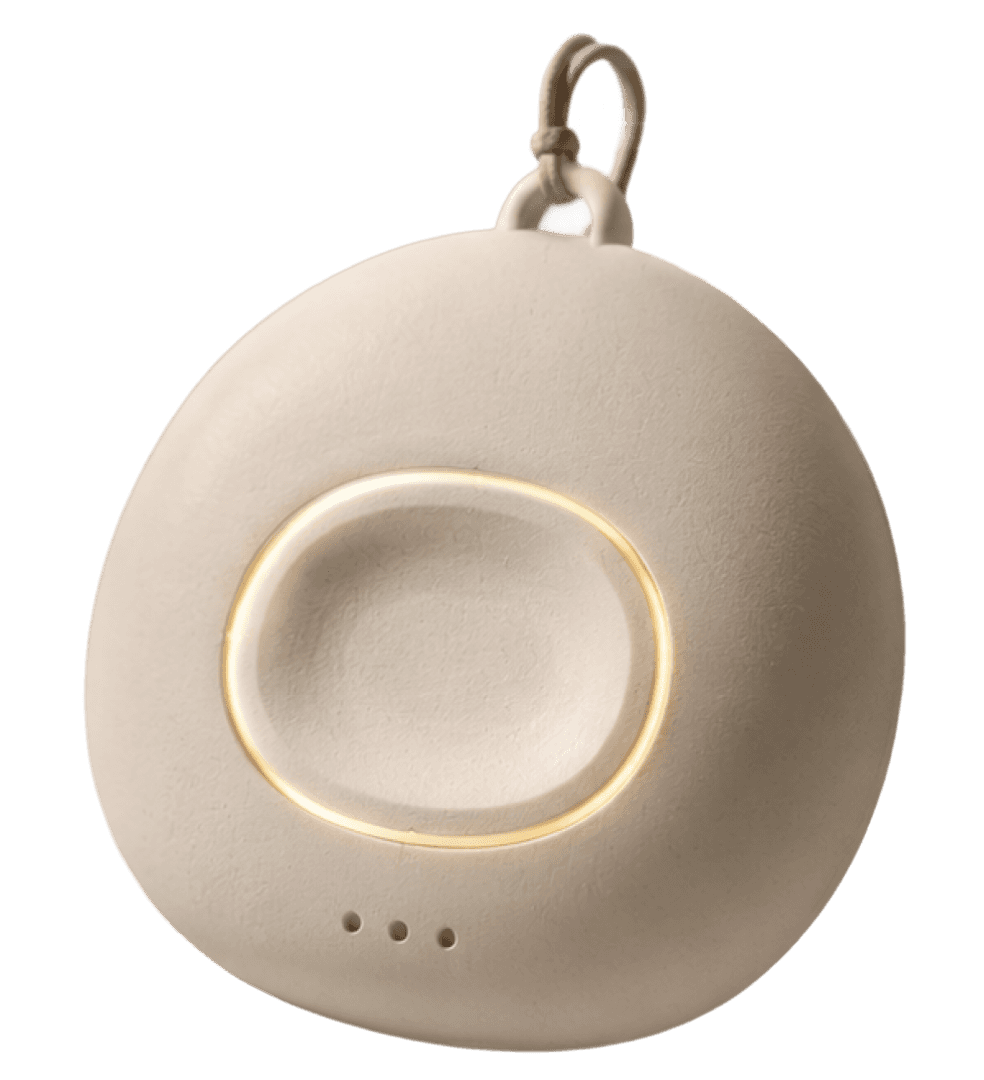
TACTILE CAPTURE OBJECT
THE WORRY STONE
Made capture tactile, private and low-pressure, turning reflection into a small physical gesture instead of another screen task.
Single tap · archive song
Double tap · record
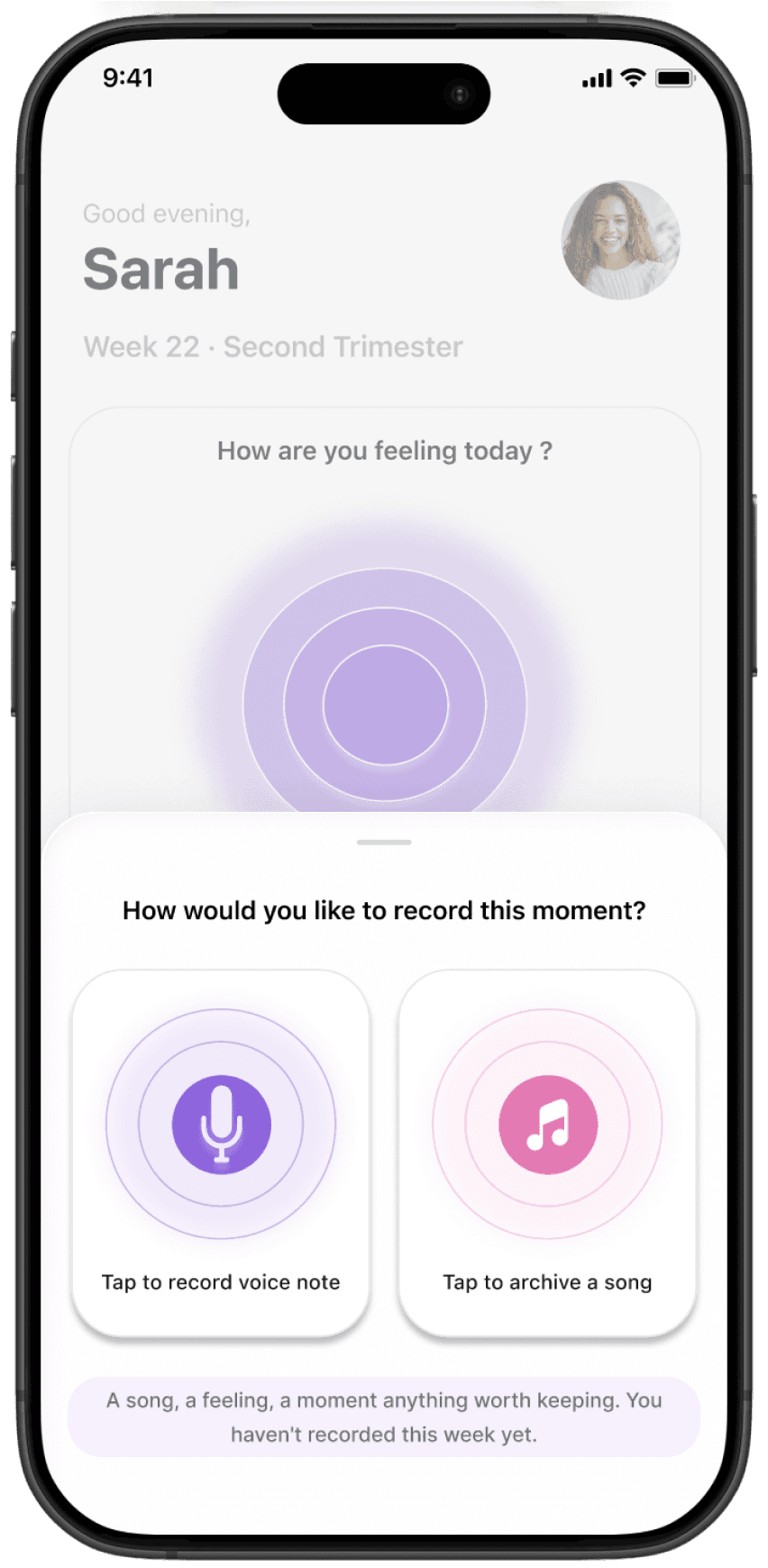
DIGITAL ARCHIVE INTERFACE
HOW THE SYSTEM WORKS
01
Emotional moment
A meaningful moment arises
02
Low-friction capture
The person taps the Worry Stone or app
Voice note
Song
Feeling tag
03
Archive entry
A voice note, song or feeling tag is saved
04
Patterns emerge
Feelings, sounds and memories become visible over time
05
Keepsake
The archive becomes something to revisit, reflect on and pass on
DESIGN ETHIC
The goal was not to diagnose, fix or optimise emotion. It was to create a low-pressure way for pregnant individuals to notice, preserve and return to meaningful moments on their own terms.
REFINEMENT EVIDENCE
The decisions were tested, then refined.
Four prototype testing sessions helped refine the final interaction details. I synthesised the written session notes into patterns, then translated each pattern into a specific design change.

Testing showed capture needed to feel simpler
Decision 01: One clear capture point
Testing showed reflection language felt too measured
Informed Decision 02: feeling over statistics
Testing showed breathe mode needed more user control
Informed Decision 03: pacing, one step and a clear exit
Testing showed the Worry Stone felt disconnected
Informed Decision 04: connected status and guidance
DESIGN DECISIONS
Four design decisions, each traced back to research.
01
GOAL: LOW-FRICTION CAPTURE
Reduce friction in emotional capture.
BEFORE
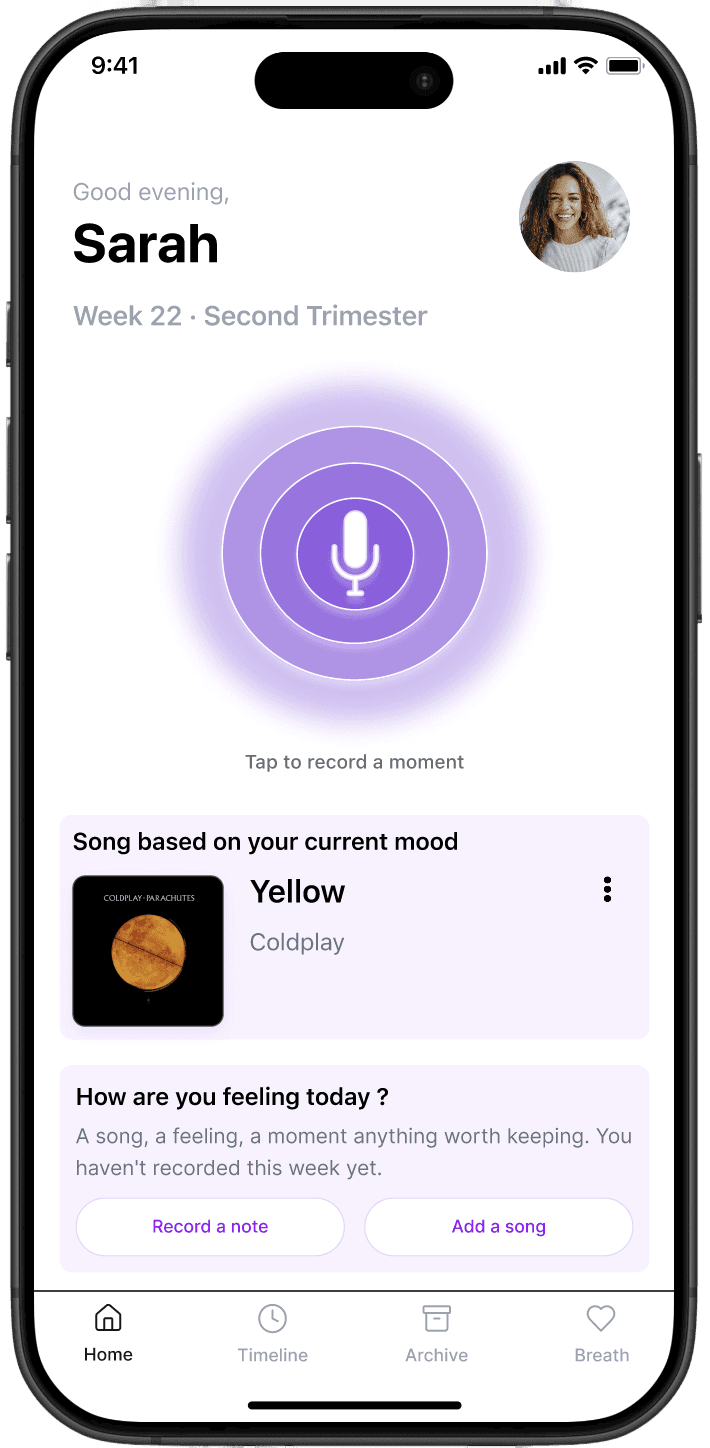
Competing capture actions
AFTER
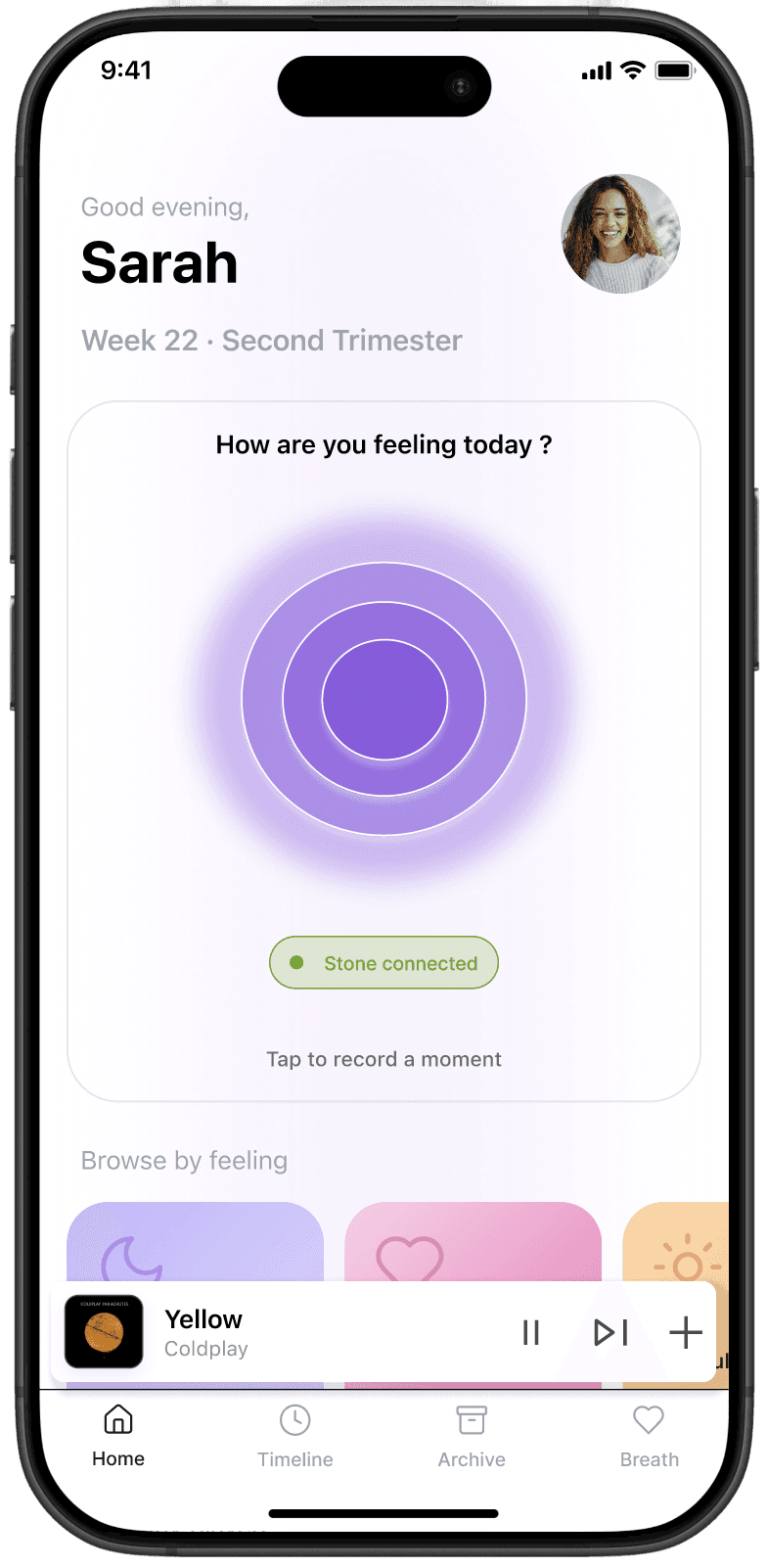
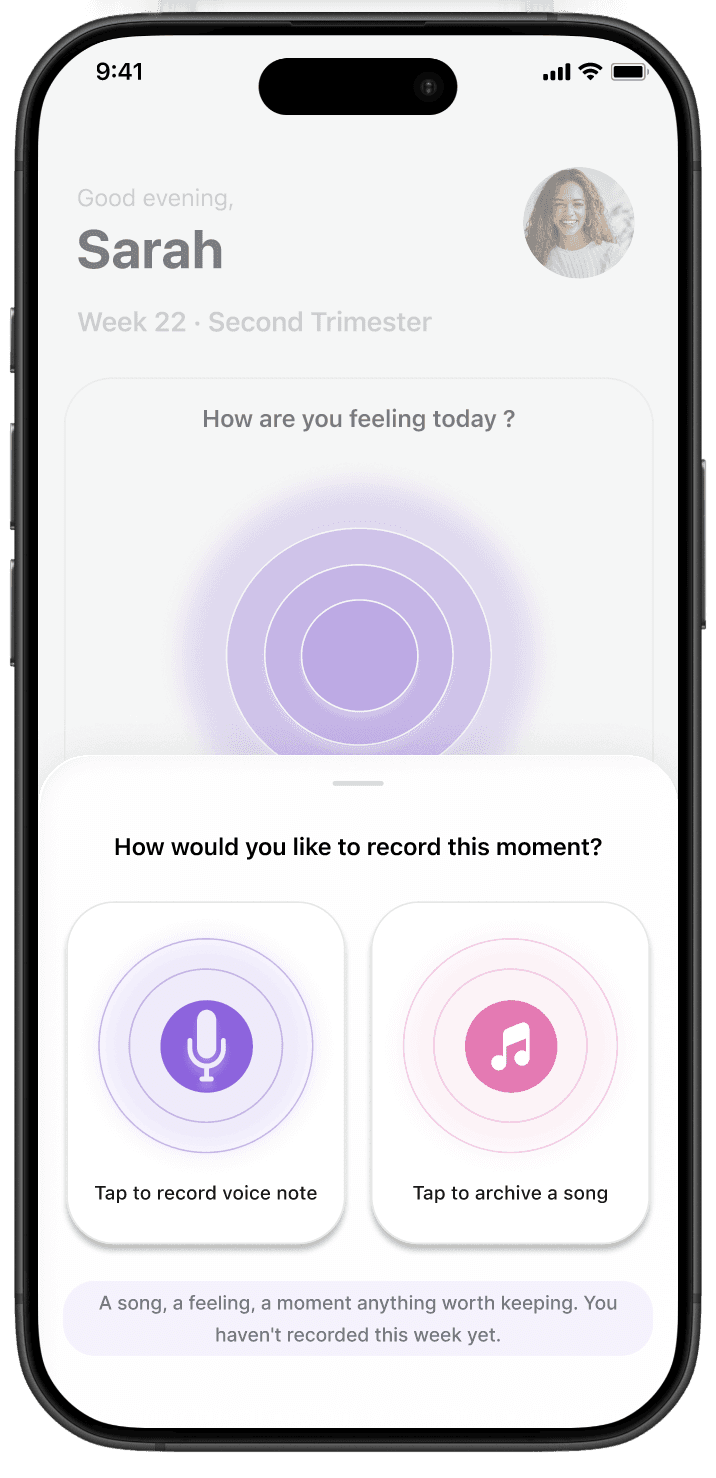
One clear capture point
INSIGHT
During overwhelm, participants had limited cognitive and emotional capacity. Multiple entry points created unnecessary friction.
DECISION
Consolidate capture into one clear entry point: tap to record a moment.
INTENDED IMPACT
Make the home screen calmer and reduce cognitive load during vulnerable moments.
02
GOAL: SELF-RECOGNITION
Shift from statistics to feeling.
Language carries meaning, not numbers.
BEFORE
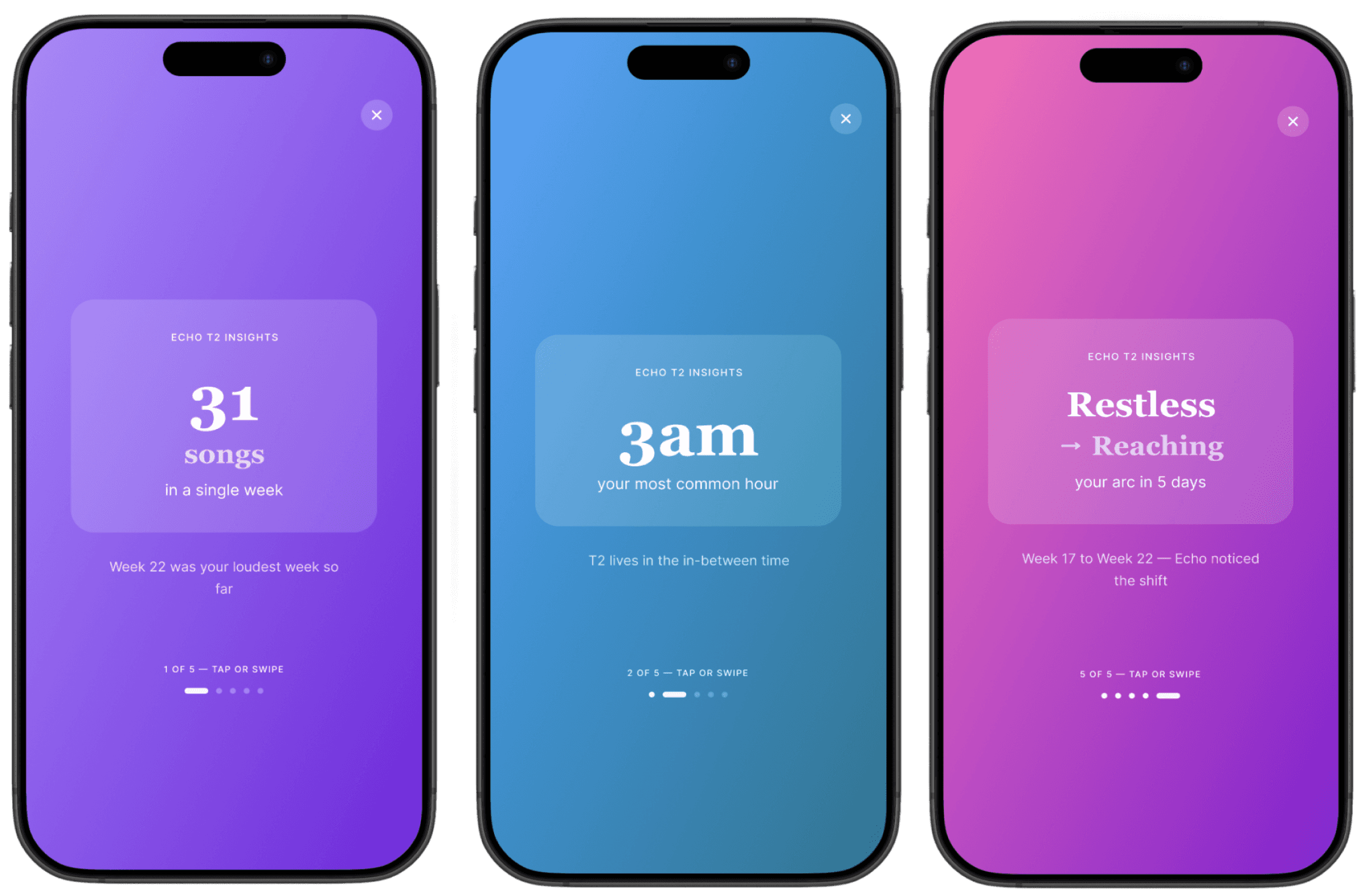
Activity stats
AFTER
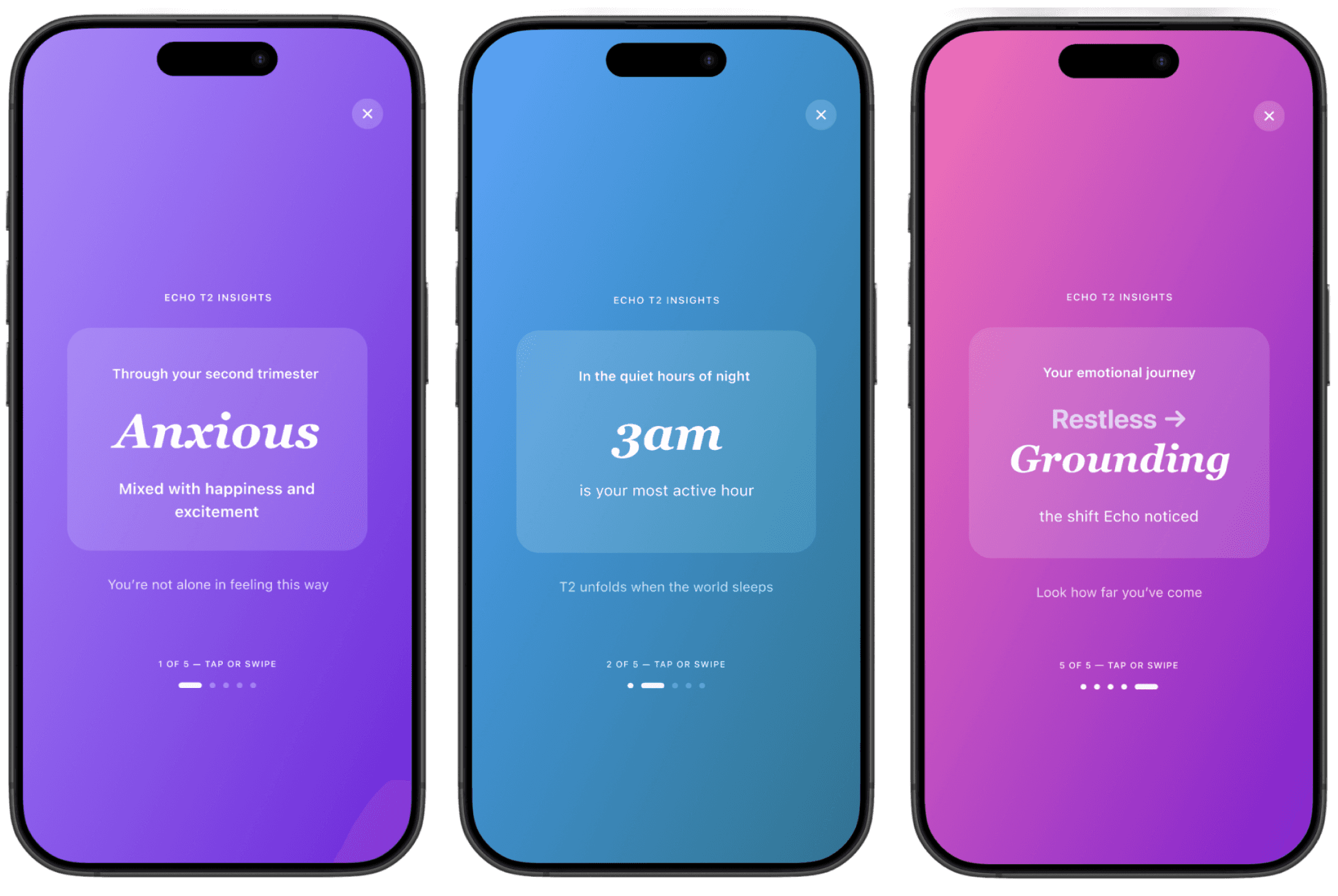
Emotional reflection
INSIGHT
The archive needed to reflect emotional meaning, not music activity. Measuring songs played felt performative rather than reflective.
DECISION
Reframe the wrapped view from statistics to reflection. Language shifted from "songs played" to "moments captured."
INTENDED IMPACT
Reframe the archive as a record of experience rather than a stats dashboard, so reflection feels personal, not performative.
03
GOAL: EMOTIONAL REGULATION
Make regulation feel controlled.
BEFORE
PROTOTYPE RECORDING
Starts immediately
No visible exit
Low user control
AFTER
PROTOTYPE RECORDING
Countdown
One step at a time
Clear exit
INSIGHT
A regulation feature that starts abruptly or removes agency can increase anxiety rather than reduce it. People needed to feel in control, not subjected to it.
DECISION
Introduce pacing through a countdown, one instruction at a time and a clear exit, so the interaction feels chosen rather than imposed.
INTENDED IMPACT
Give users more control over a sensitive interaction through pacing, one instruction at a time, and a clear exit.
04
GOAL: FUTURE INHERITANCE
Make the physical object part of the system.
01
Low-friction capture
One tap on the stone captures the moment.
02
Embodied memory
Holding the stone ties the object to the moment.
03
Future inheritance
The NFC chip seals the archive into the object.
INSIGHT
The Worry Stone was central to the concept, but early screens treated it as peripheral. Participants needed to understand what it did and how it connected to the archive.
DECISION
Surface the Worry Stone's connected status and guidance in the app, making the object feel like an integrated part of the archive.

PROTOTYPE RECORDING
INTENDED IMPACT
Connect the physical and digital layers into one keepsake that can be revisited and passed on, not an app with a detached accessory.
MY CONTRIBUTION
What I researched, translated, and shaped.
My role focused on translating research into experience direction, helping shape the concept, key flows and design decisions across the team.
01
RESEARCH
Prepared interview questions
Conducted 2 interviews and 2 testing sessions
Coded notes and feedback
02
SYNTHESIS
Synthesised 10 team-wide interviews
Contributed to 6 theme clusters
Translated quotes into design themes
03
DESIGN
Mapped insights to goals and iterations
Refined Home, Archive, Breathe Mode and Worry Stone
Used testing to reduce friction and clarify capture
04
ALIGNMENT
Kept the concept grounded in emotional safety and low-pressure reflection
Aligned final decisions with research themes
Ensured physical and digital served the same purpose
KEY TENSIONS I DESIGNED AROUND
Capture vs Burden

Preserve meaningful moments without making reflection feel like another task.
Reflection vs Measurement

Reveal emotional patterns without making people feel tracked or analysed.
Digital vs Tactile

Make the Stone feel part of the experience, not a disconnected accessory.
REFLECTION
Designing for emotion, not just usability.
Design around existing behaviours.
Build on what people already do, rather than asking them to create new rituals.
Low friction can be emotional care.
In sensitive contexts, reducing effort is not just a usability goal.
Physical and digital should carry the same meaning.
A hybrid system only works when the object and interface feel emotionally connected.
Research synthesis is where design begins.
The most important decisions came from interpreting emotional patterns, not just designing screens.
KEY TAKEAWAY
The most meaningful design decisions were not the most visually complex. They helped participants feel seen, supported and able to preserve something of themselves.