PRODUCT & CONTENT DESIGN · INFORMATION ARCHITECTURE · 2026
ONCIO
Turning ONCIO from a content showcase into a guided buyer experience.
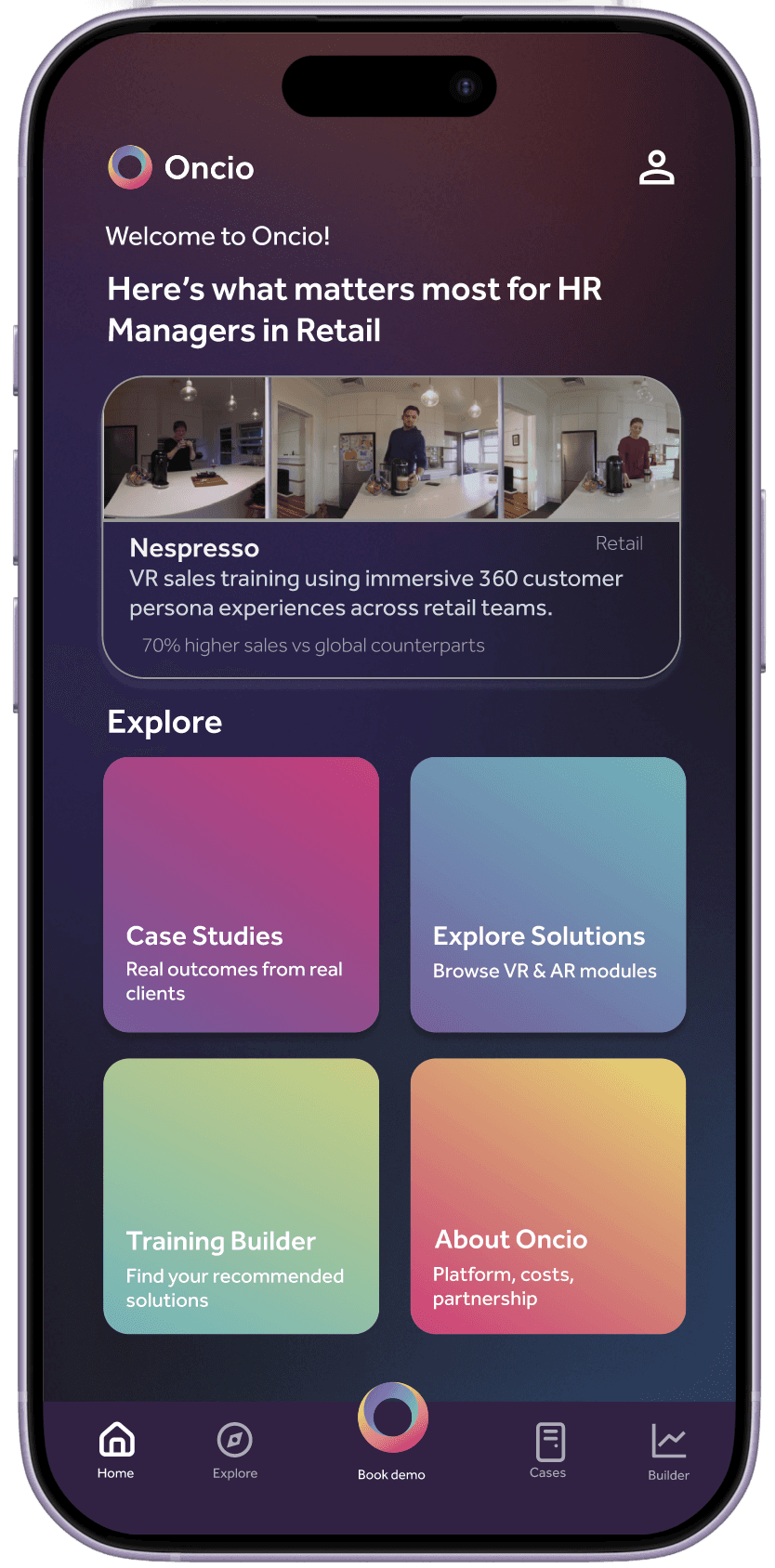
ONCIO is Start Beyond's immersive learning app, built to showcase VR and AR training experiences for enterprise clients. While the content was strong, prospective buyers could not easily tell which experiences were relevant to them, how they created business value, or what to do next.
I helped reframe the app from a passive showcase into a guided experience that supports understanding, evaluation and enquiry.
PRODUCT STRATEGY
CONTENT DESIGN
INFORMATION ARCHITECTURE
RESEARCH SYNTHESIS
ROLE
Product Designer & Project Lead
TEAM
5-person team
Start Beyond client project
DURATION
Feb to May 2026
TYPE
Product and content design
OUTCOME
Buyer journey redesign
Prioritised roadmap
Client handover recommendations
QUICK OVERVIEW
THE PROBLEM
Buyers could browse immersive training examples, but could not easily understand relevance, proof of value or next steps.
THE SHIFT
We reframed the app around how enterprise buyers evaluate training solutions.
MY ROLE
I led research synthesis, information architecture, content strategy and prioritisation across a 5-person client project.
THE REAL PROBLEM
The challenge wasn’t content. It was decision-making.
Start Beyond already had strong immersive training content. The issue was not what they offered, but how buyers made sense of it. Testing showed that users could browse examples, but struggled to connect them to their industry, role and training needs.
"I can see what the experiences are,
but I can't tell if this would work for my team."
SYNTHESISED FROM USER TESTING FEEDBACK
CURRENT JOURNEY
01
Browse
02
Watch
03
Leave
DESIRED JOURNEY
01
Understand
02
Evaluate
03
Trust
04
Enquire
KEY OPPORTUNITIES:
surface proof earlier, reduce navigation friction, create a clear next step, personalise by user context.
REFRAMING THE OPPORTUNITY
WE STARTED ASKING
"How do we showcase more immersive learning experiences?"
REFRAMED TO
"How might we help enterprise buyers evaluate, trust and act on the value of immersive learning?"
DESIGN PRINCIPLES
01
Lead with outcomes, not technology
Surface business results first. Technology is the enabler, not the story.
02
Reduce cognitive effort
Simplify navigation and hierarchy so users can evaluate without friction.
03
Create pathways to action
Every screen should move the user closer to a confident decision.
ROLE AND CONTRIBUTION
What I led, shaped, and delivered.
My role sat between research synthesis, product direction and client handover. I helped the team translate user uncertainty into a clearer, more guided buyer experience.

RESEARCH
UNDERSTAND

PRODUCT DIRECTION
DEFINE

CLIENT HANDOVER
DELIVER
Led client communication and weekly alignment
Synthesised user testing into opportunity areas
Shaped the information architecture and content strategy
Designed the Request a Demo flow and Training Builder direction
Reframed case studies around business proof
Consolidated recommendations into a prioritised roadmap
KEY EXPERIENCES SHAPED

PERSONALISED ONBOARDING

REQUEST A DEMO

TRAINING BUILDER

CASE STUDIES

FINAL ROADMAP
From user uncertainty to clear, actionable outcomes.
DESIGN DECISIONS
Four design decisions, each traced back to research.
01
PROPOSED FEATURE
GOAL: EARLY RELEVANCE
Personalise the experience before users see content.
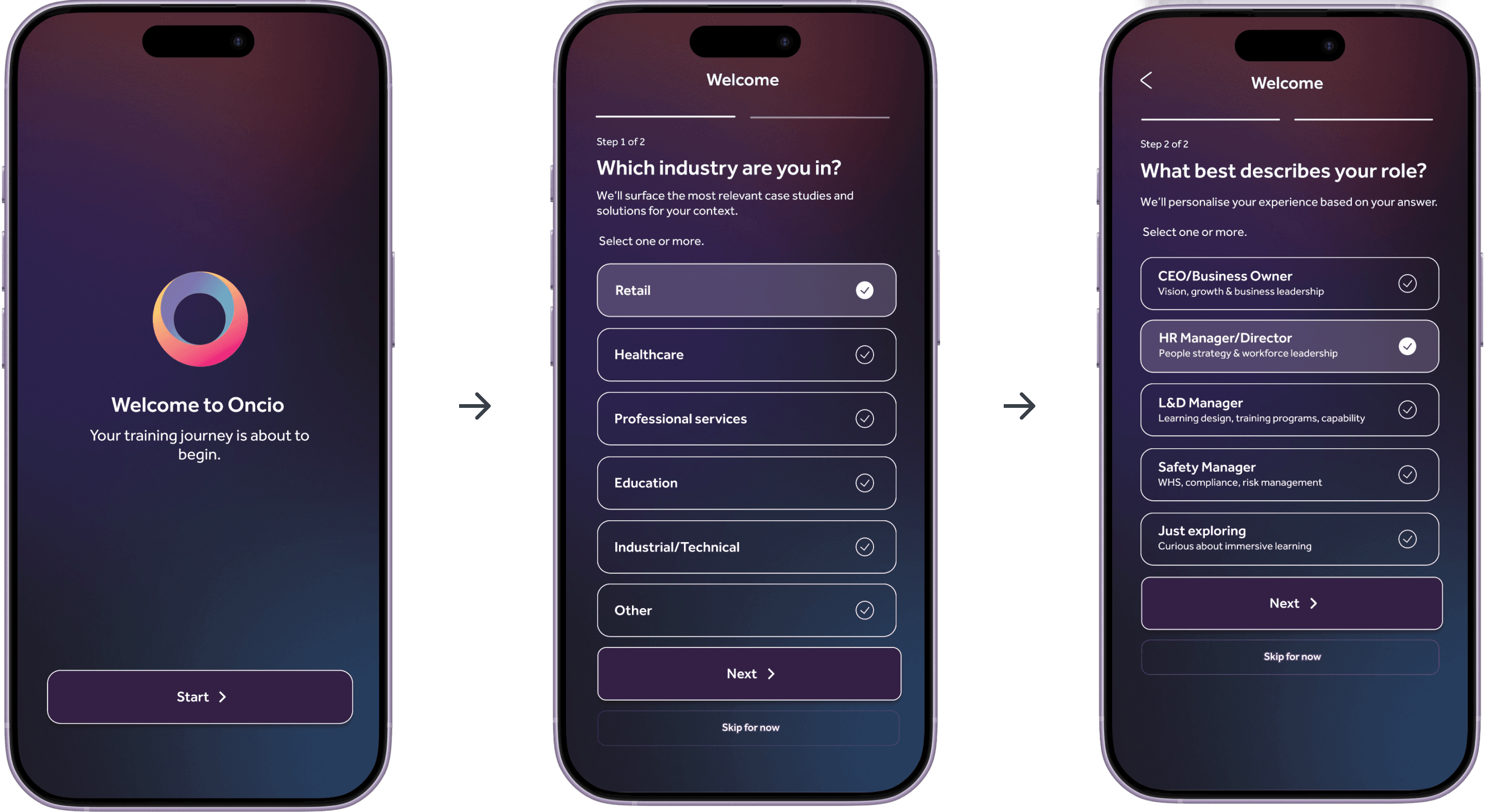
ONBOARDING FLOW
Welcome → Industry → Role
INSIGHT
Users struggled to identify which examples were relevant to their industry, role and training goals.
DECISION
Introduce a lightweight onboarding flow to capture role and industry before showing recommended content.
INTENDED IMPACT
Help buyers connect examples to their own team earlier in the journey.
02
REDESIGNED EXPERIENCE
GOAL: DECISION-LED NAVIGATION
Restructure navigation around buyer questions.
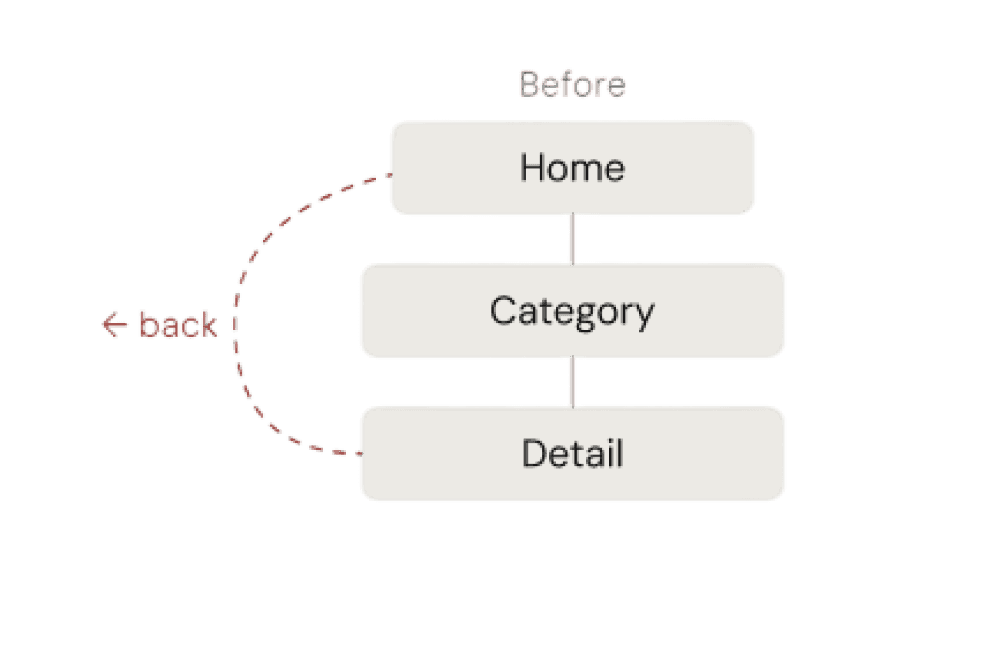
BEFORE
Category-led browsing

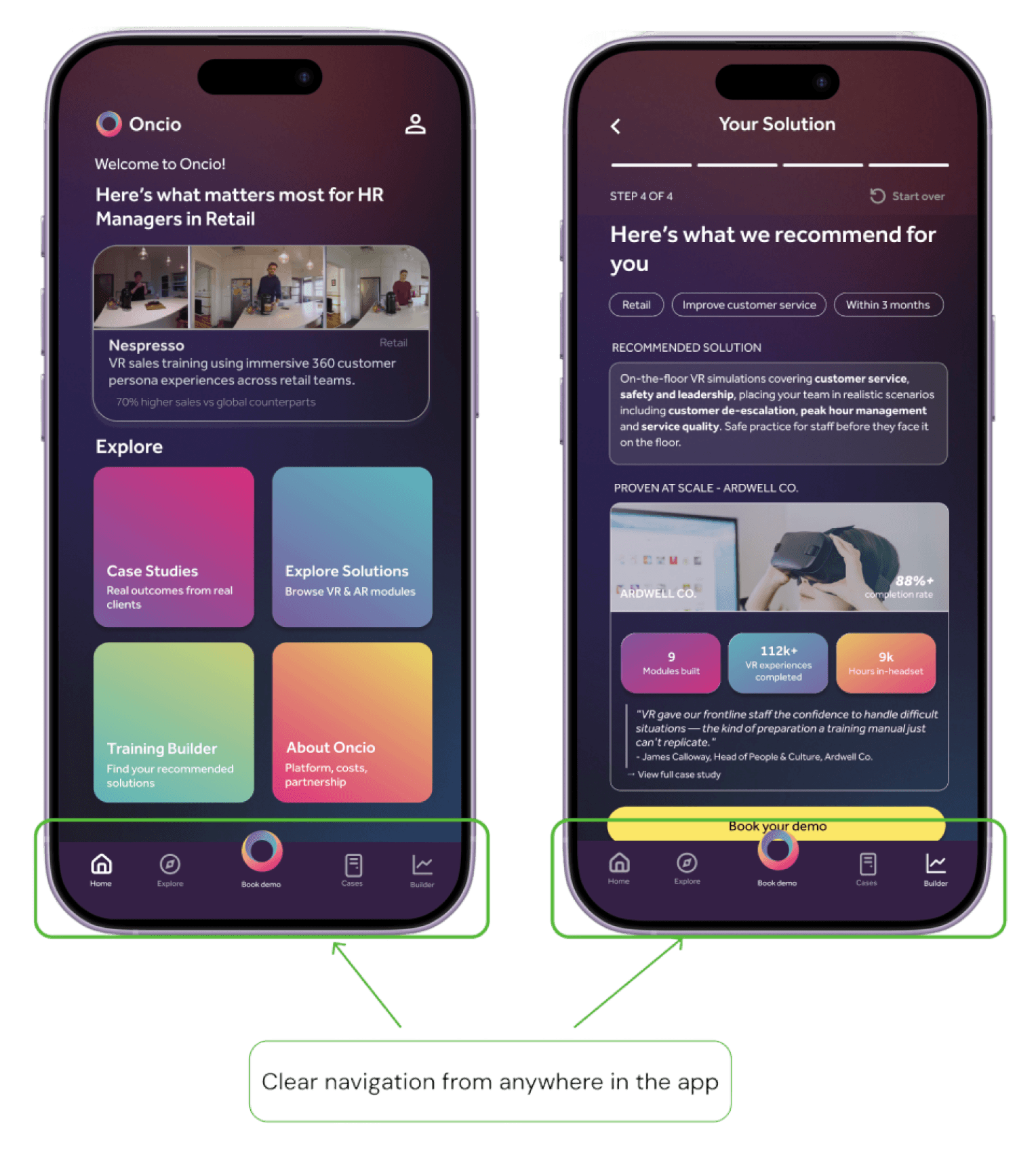
AFTER
Decision-led navigation
Home
Explore
Demo
Cases
Builder
INSIGHT
Users relied on back navigation because the original structure was organised around content categories, not the questions buyers were trying to answer.
DECISION
Redesign the navigation around a clearer path: understand the offer, explore relevant solutions, evaluate proof and move toward enquiry.
INTENDED IMPACT
Shift the experience from passive browsing to active evaluation.
03
PROPOSED FEATURE
GOAL: BUILD TRUST THROUGH PROOF
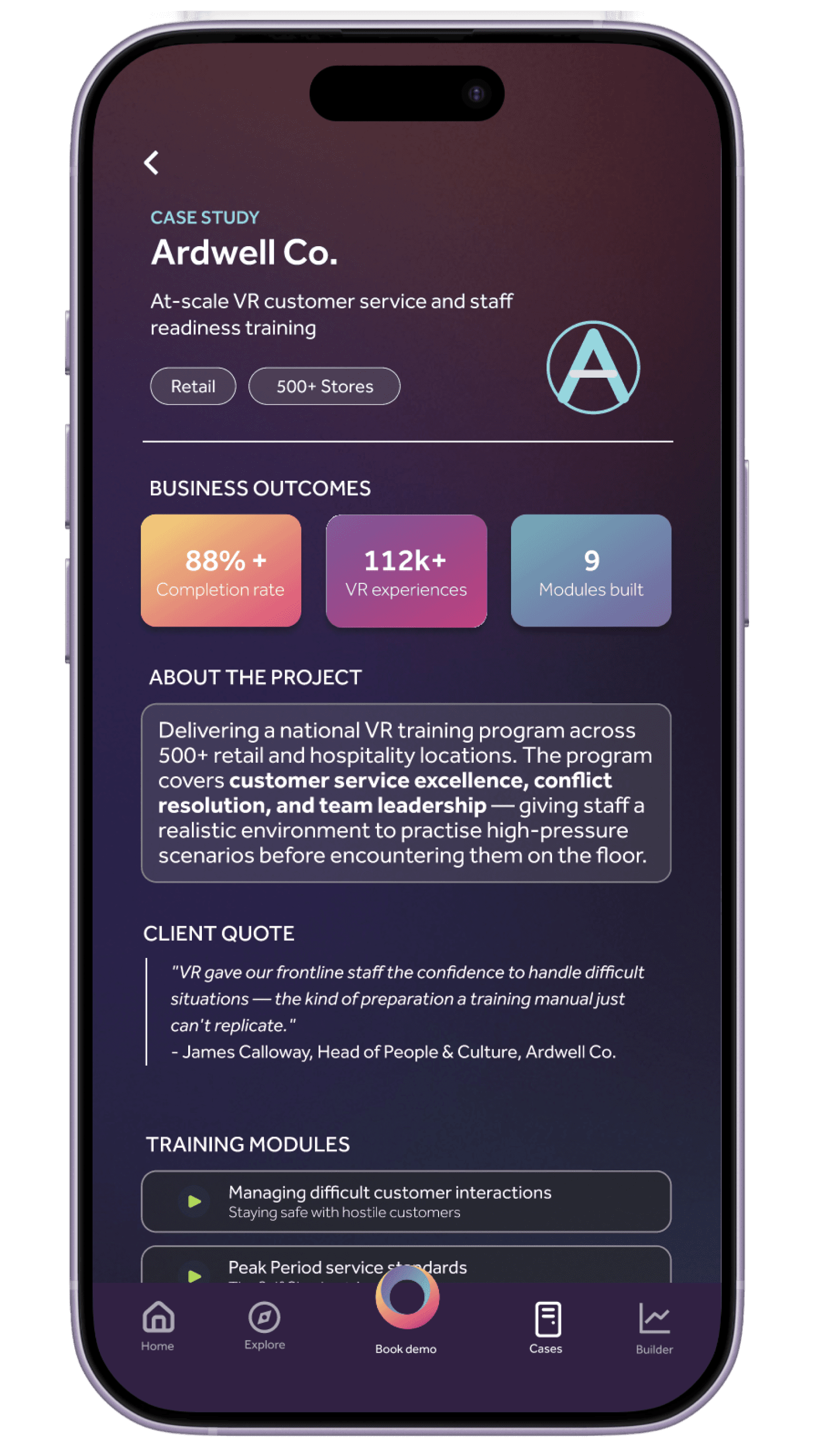
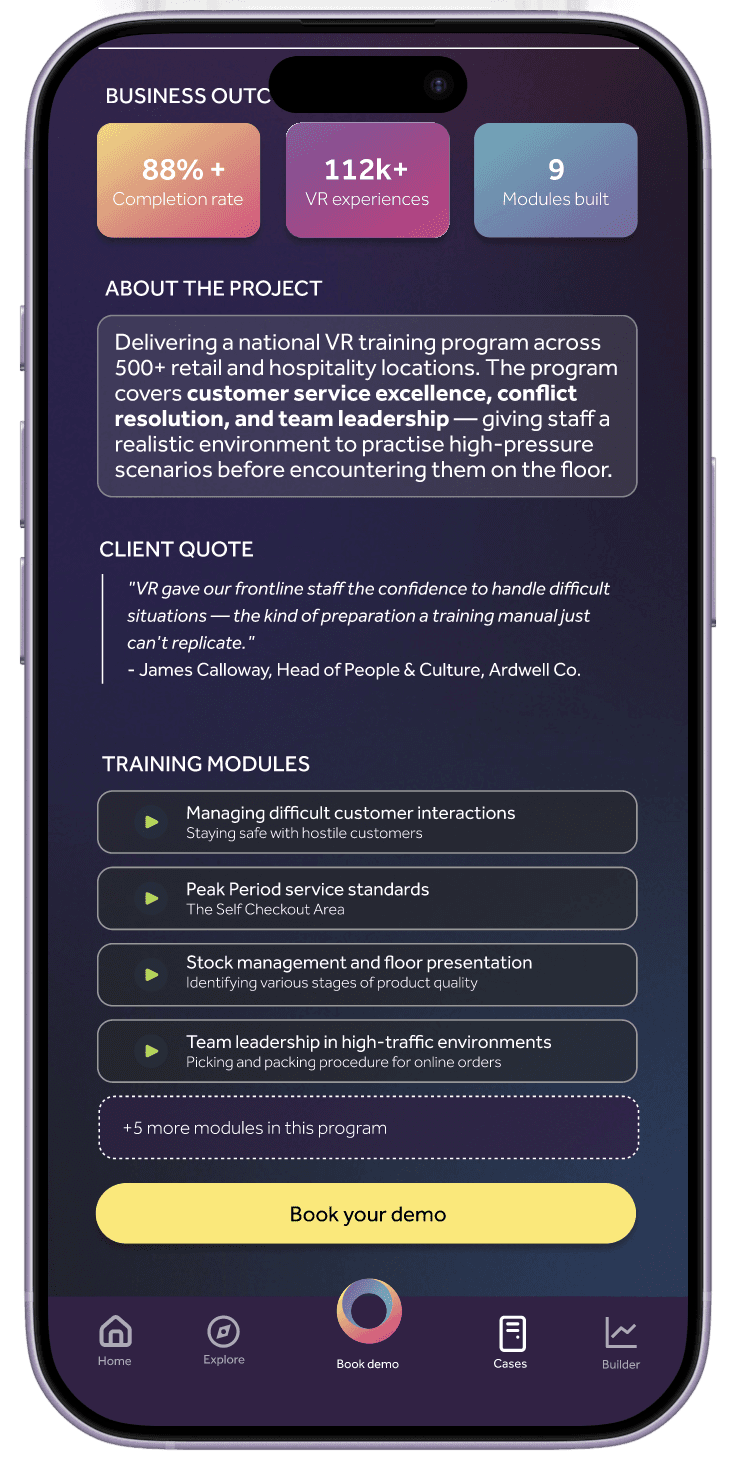
Turn case studies into evidence for decision-making.
INSIGHT
Buyers wanted proof before engaging. Immersive demos alone did not help them judge whether the solution would work for their organisation.
DECISION
Redesign case studies to lead with measurable outcomes, implementation scale, industry relevance and client success before feature details.
INTENDED IMPACT
Help buyers evaluate business fit, not just browse immersive capability.
04
PROPOSED FEATURE
GOAL: CLEAR PATH TO ENQUIRY
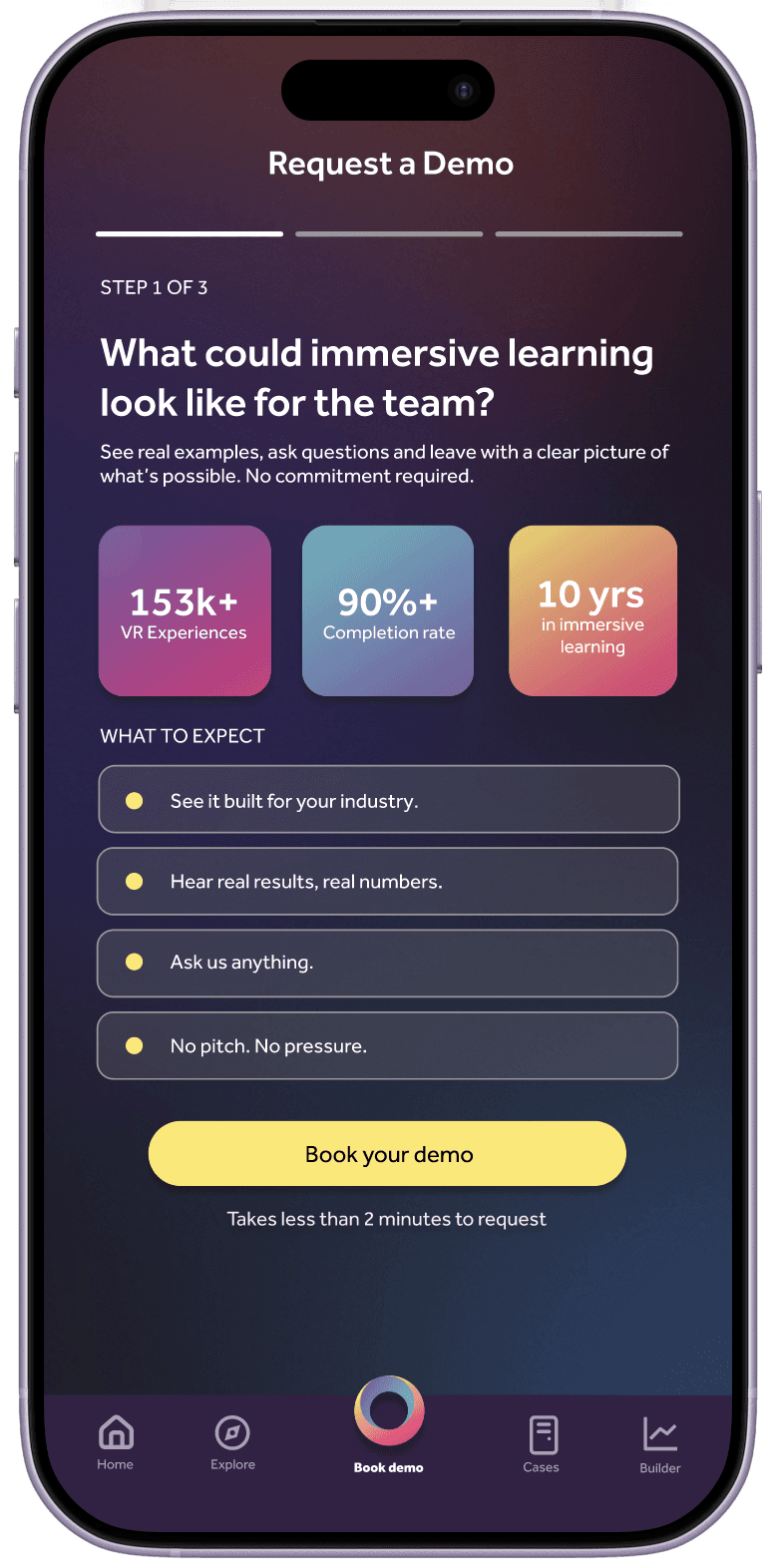
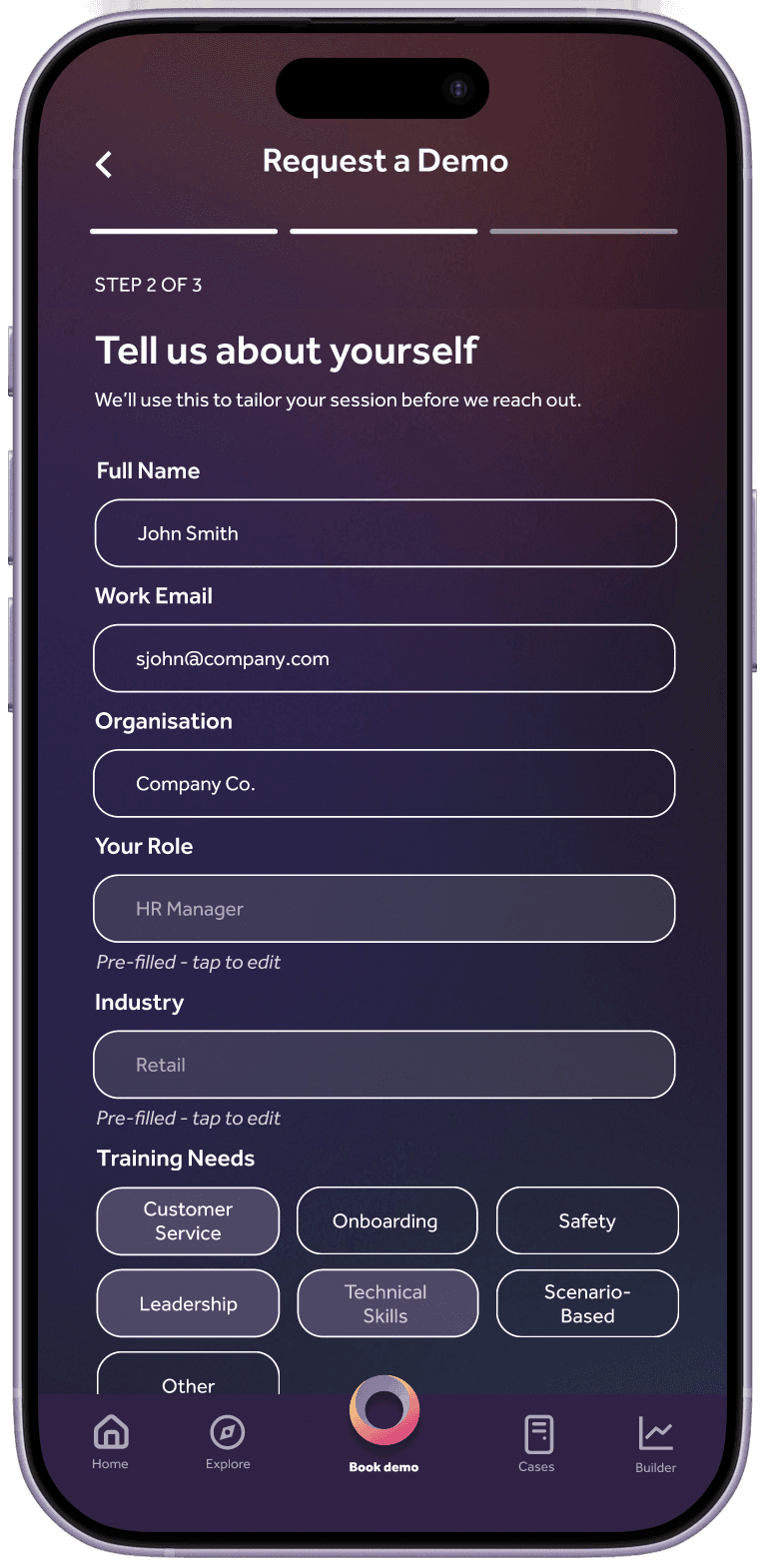
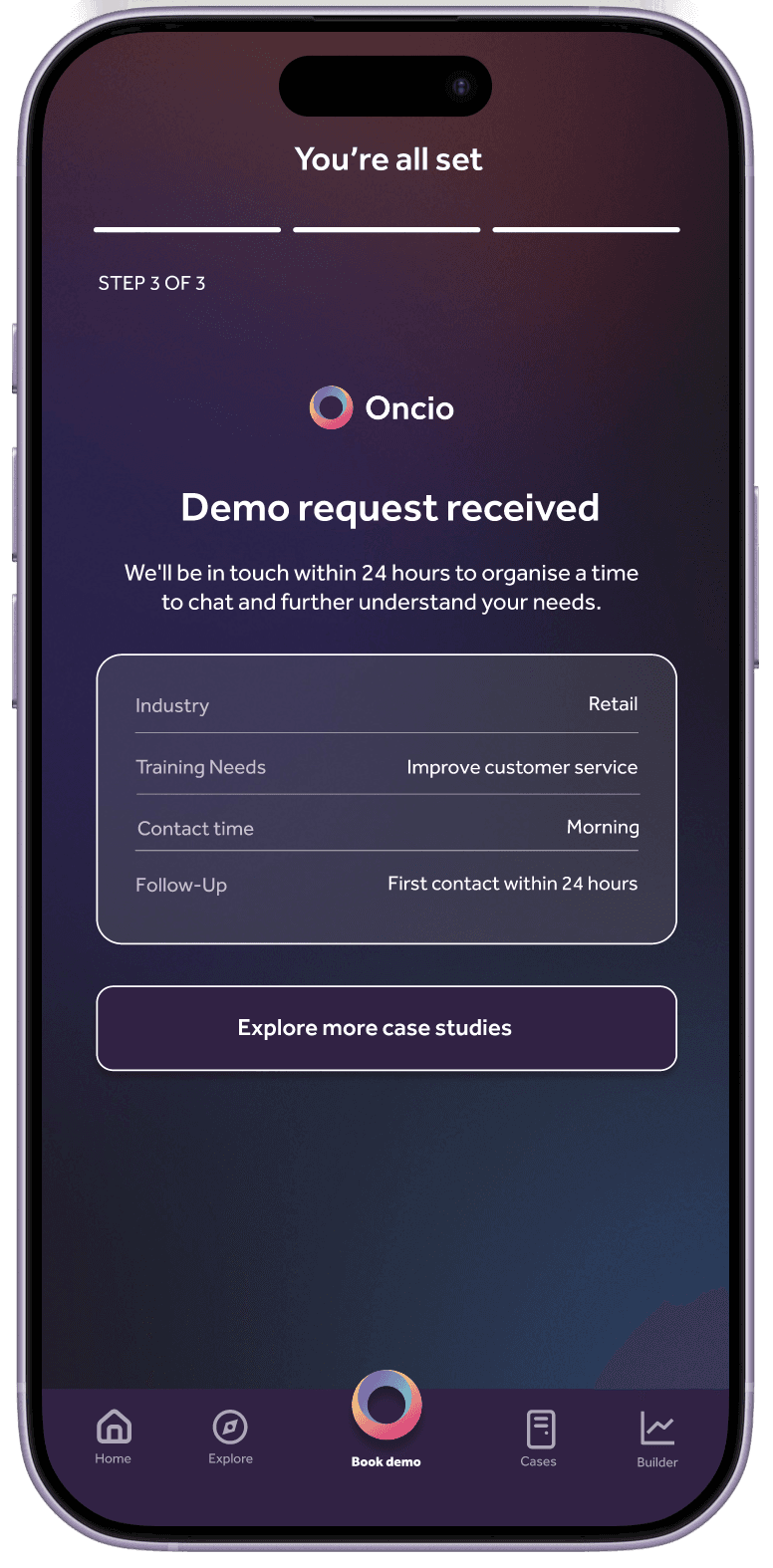
Turn interest into a structured enquiry path.
INSIGHT
Users had no obvious pathway from interest to enquiry after exploring the content.
DECISION
Create a dedicated multi-step Request a Demo flow, supported by persistent CTAs across key sections of the app.
INTENDED IMPACT
Give interested buyers a clear next step and capture useful context for follow-up.
PRODUCT THINKING AND PRIORITISATION
We didn't propose a full rebuild. We made commercially realistic decisions.
PRIORITISED RECOMMENDATIONS
MUST HAVE
High impact · Low to mid effort
Guided user journey
Persistent navigation
Request a Demo CTA
Outcome-focused case studies
SHOULD HAVE
High impact · Mid effort
Simplified onboarding
Multi-step demo form
Stronger storytelling
COULD HAVE
Lower priority · Higher effort
Interactive module carousel
Prioritised based on buyer value, business impact and implementation feasibility.
KEY TRADEOFFS
TRADEOFF 01
Complete redesign vs incremental improvement
We focused on high-impact changes that could work within the existing ecosystem.
TRADEOFF 02
Personalisation vs initial friction
Onboarding added one step, but improved relevance across the rest of the experience.
TRADEOFF 03
Technology showcase vs business evidence
Research showed buyers needed proof of value before details about capability.
REFLECTION
Designing for decisions, not just usability.
Problem framing shapes the outcome.
The most valuable shift came from reframing the app around buyer clarity and evaluation, not simply adding more content.
Research synthesis is a design skill.
The work came from translating uncertainty, hesitation and business needs into clearer product and content decisions.
Constraints sharpened the solution.
Working within the existing app pushed the redesign toward practical, high-impact changes instead of idealised solutions.
KEY TAKEAWAY
Good product design does not just help people use something. It helps them understand value, make decisions and know what to do next.